
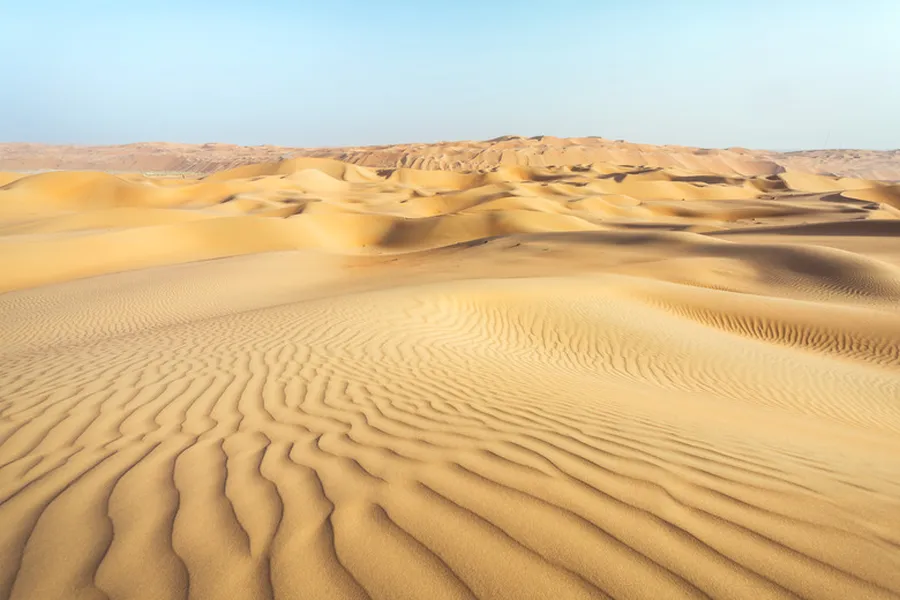
Quick Facts
Deserts cover roughly one-third of Earth's land surface. While many are hot, the largest desert on the planet is actually the cold, icy continent of Antarctica.
Quick Answer: Deserts of the World
Deserts are defined as regions receiving less than 250 mm of rainfall per year. They cover about 33% of Earth's land. The largest is Antarctica (14 million km²), followed by the Sahara (9.2 million km²). Each desert has unique adaptations in wildlife, plants, and landscapes shaped by extreme conditions.
Largest Deserts in the World by Area
| Rank | Desert | Area (km²) | Location | Type |
|---|---|---|---|---|
| 1 | Antarctic | 14,000,000 | Antarctica | Polar |
| 2 | Sahara | 9,200,000 | North Africa | Hot |
| 3 | Arabian | 2,330,000 | Middle East | Hot |
| 4 | Gobi | 1,295,000 | China/Mongolia | Cold |
| 5 | Kalahari | 900,000 | Southern Africa | Hot |
The Sahara Desert – The Largest Hot Desert
Spanning 9.2 million square kilometers across 11 countries in North Africa, the Sahara is bigger than the United States. It features massive sand dunes reaching 180 meters high, rocky plateaus, and rare oases that support life. Daytime temperatures can exceed 50°C while nights drop near freezing.
Antarctic Desert – The Largest Desert on Earth
Despite being covered in ice, Antarctica receives very little precipitation (less than 200 mm per year in most areas), qualifying it as a desert. It holds about 70% of the world's fresh water in frozen form.
Arabian Desert and the Empty Quarter
The Arabian Desert covers most of the Arabian Peninsula. Its Rub' al Khali (Empty Quarter) is one of the most inhospitable places on Earth, with sand dunes over 250 meters tall.
Atacama Desert – The Driest Place on Earth
Located in Chile, parts of the Atacama have gone decades without measurable rain. It is so dry that NASA uses it to test Mars rovers. Despite the aridity, it hosts unique microbial life and stunning salt flats.
Types of Deserts and Their Unique Characteristics
- Hot Deserts — Extreme daytime heat, cold nights (Sahara, Arabian)
- Cold Deserts — Low temperatures, snow possible (Gobi, Great Basin)
- Polar Deserts — Frozen, very low precipitation (Antarctica, Arctic)
- Coastal Deserts — Fog provides moisture (Atacama, Namib)
FAQs – Deserts of the World
What defines a desert?
A region that receives less than 250 mm (10 inches) of precipitation per year.
Are there deserts in Europe?
Yes, though small. The Tabernas Desert in Spain is the only true desert on the European mainland.
Do deserts support life?
Yes. Many deserts have highly adapted plants (cacti, acacias) and animals (camels, fennec foxes) that survive with minimal water.
Conclusion
From the scorching sands of the Sahara to the frozen expanse of Antarctica, deserts showcase nature’s incredible ability to create life in the harshest conditions. They play vital roles in global climate, store ancient history, and remind us of the planet’s remarkable diversity.
Continue your geography journey with countries with largest land area, longest rivers, and highest mountains in the world.